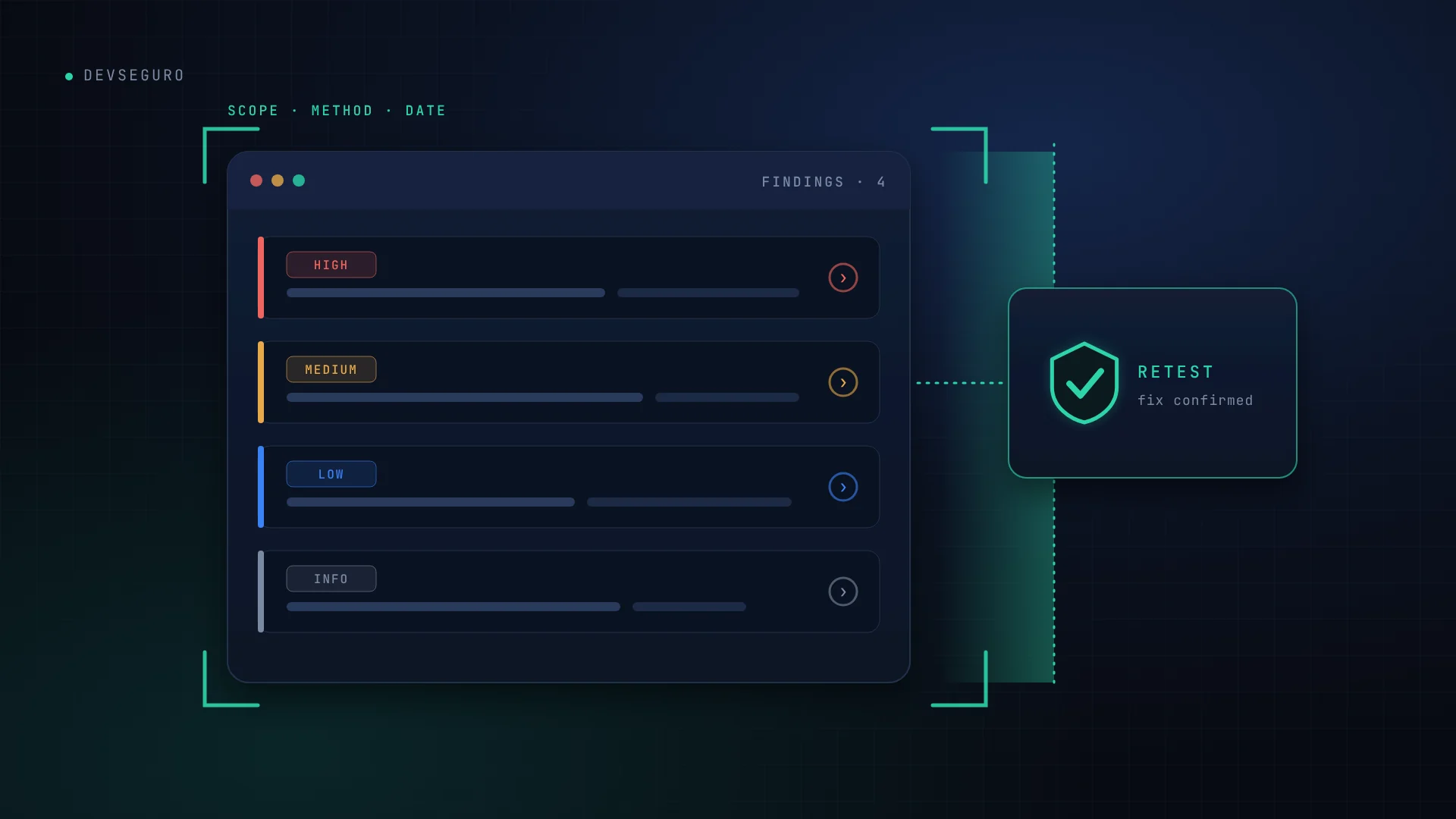
Most people picture a security assessment as a pass/fail exam: either your site is "secure" or it isn't. In practice, that's not how it works — and treating it that way is how real risk gets missed. An assessment produces a list of findings, each with a severity rating and evidence, not a single verdict. Here's what actually ends up in that report, and why "no critical findings" is not the same sentence as "secure."
The report is a list, not a grade
A real assessment doesn't hand back a score out of 100. It hands back individual findings — specific, reproducible issues, each described with what was found, where, how severe it is, and what to do about it. A typical finding looks something like this:
Impact: an authenticated but lower-privileged user can reach an admin-only endpoint. Recommendation: add a server-side role check before this route executes.
Ten findings that are all "low" severity paint a very different picture than two findings rated "critical." Neither number alone tells you whether to launch tomorrow or stop everything — the severity and the specific exposure matter more than the count.
Severity is about impact and reachability, not just the bug
The same underlying flaw can rate differently depending on context. A cross-site scripting bug on an internal admin tool behind a login and a VPN is a different severity than the identical bug on a public checkout page. A good report explains that reasoning — not just "XSS found," but why it was rated the way it was, so you can sanity-check the call yourself instead of taking severity on faith.
Roughly, severity tends to track two questions
- How much damage is possible if this is exploited — data exposure, account takeover, full compromise?
- How easy is it to reach — does it need authentication, specific conditions, or is it open to anyone on the internet?
What a clean report doesn't mean
"No critical or high findings" is genuinely good news — but it describes what was found using the agreed scope and methodology, at that point in time. It doesn't mean the system is immune to anything discovered afterward, and it doesn't cover what was explicitly out of scope. A Security Check (automated scanning) and a full Web App Security Assessment (manual, authenticated testing) can produce very different pictures of the same application, because they're looking with different depth.
What actually belongs in a good report
- An executive summary a non-technical stakeholder can act on without reading the technical detail
- Each finding with severity, evidence, and a specific fix — not just "improve security"
- What was in scope and what wasn't, stated plainly
- The methodology used, so the reader knows how thorough the testing actually was
- A retest step once fixes ship, confirming the finding is actually resolved — not just marked closed
The honest takeaway
A security assessment isn't a certificate that says "safe." It's a snapshot, scoped and dated, of what a tester could find using a given method in a given window of time. That's genuinely useful — it turns "we think we're probably fine" into a specific, evidenced list you can act on — but only if you read it as a snapshot, not a guarantee. Anyone promising you a 100% secure system after one assessment is selling something the field can't actually deliver.
This is a sensitive-adjacent topic in the sense that it touches on risk and trust decisions for a business — if you're weighing a real security decision for your own site right now, our Cybersecurity page walks through the actual service tiers, or you can talk to the AI Advisor directly.