AI-assisted development is changing how businesses create websites and applications. Founders can prototype ideas quickly, developers can accelerate routine tasks, and small teams can build features that once required substantially more time.
But speed is not the same as security.
An AI-generated website can look polished and function correctly while containing weaknesses in its authentication, authorization, data validation, dependency management, or deployment configuration.
The risk is not that AI-built software is automatically insecure. The risk is treating generated code as trustworthy without testing how it behaves under real-world conditions.
1. Working features can hide broken access controls
Suppose an application lets customers view their invoices through a URL containing an invoice identifier.
The interface may work exactly as intended. But if the server does not verify that the authenticated customer owns the requested invoice, someone may be able to access another customer’s information by changing the identifier.
This is an example of broken access control, a major category in the OWASP Top 10:2025.
How to reduce the risk
- Enforce authorization on the server for every sensitive operation.
- Test access boundaries between different users and roles.
- Avoid relying on hidden buttons or client-side checks as security controls.
- Include negative authorization tests in the development process.
2. Authentication may be implemented incorrectly
AI-generated code may produce a login form without fully addressing the surrounding security requirements.
Depending on the implementation, risks can include weak session handling, insecure password recovery, insufficient rate limiting, or inappropriate token storage.
How to reduce the risk
Use well-maintained authentication frameworks or trusted identity providers where appropriate. Implement secure session management, MFA for privileged access, sensible recovery procedures, and rate limiting. Test the complete authentication flow, not just the successful login.
3. Dependencies may introduce additional exposure
Modern applications rely on external packages, frameworks, libraries, and build tools.
Generated code can introduce unnecessary dependencies or use components that require further review. The risk also extends beyond the code itself to package repositories, build pipelines, and software distribution.
The OWASP 2025 framework explicitly recognizes software supply chain failures as a major application security category.
How to reduce the risk
- Review and minimize dependencies.
- Track versions and relevant security advisories.
- Use lockfiles and controlled build processes.
- Scan dependencies as part of development and maintenance.
- Review changes before deploying them to production.
4. Sensitive information can be handled incorrectly
A generated feature may collect more information than necessary, log confidential values, expose internal errors, or place secrets in frontend code.
A private API key embedded in browser-delivered JavaScript, for example, should be treated as exposed to anyone who can inspect the delivered code.
How to reduce the risk
Keep server-side secrets out of client-side bundles, use managed secret storage where practical, minimize sensitive logging, and validate that users can access only the data they are authorized to see.
5. Security configuration may be overlooked
A website that works locally may not be ready for production.
Debug settings, overly permissive access rules, exposed storage, missing security headers, and weak deployment permissions can create vulnerabilities even when the application code is otherwise well written.
Use separate development and production environments, restrict deployment permissions, and review the final hosting configuration before launch.
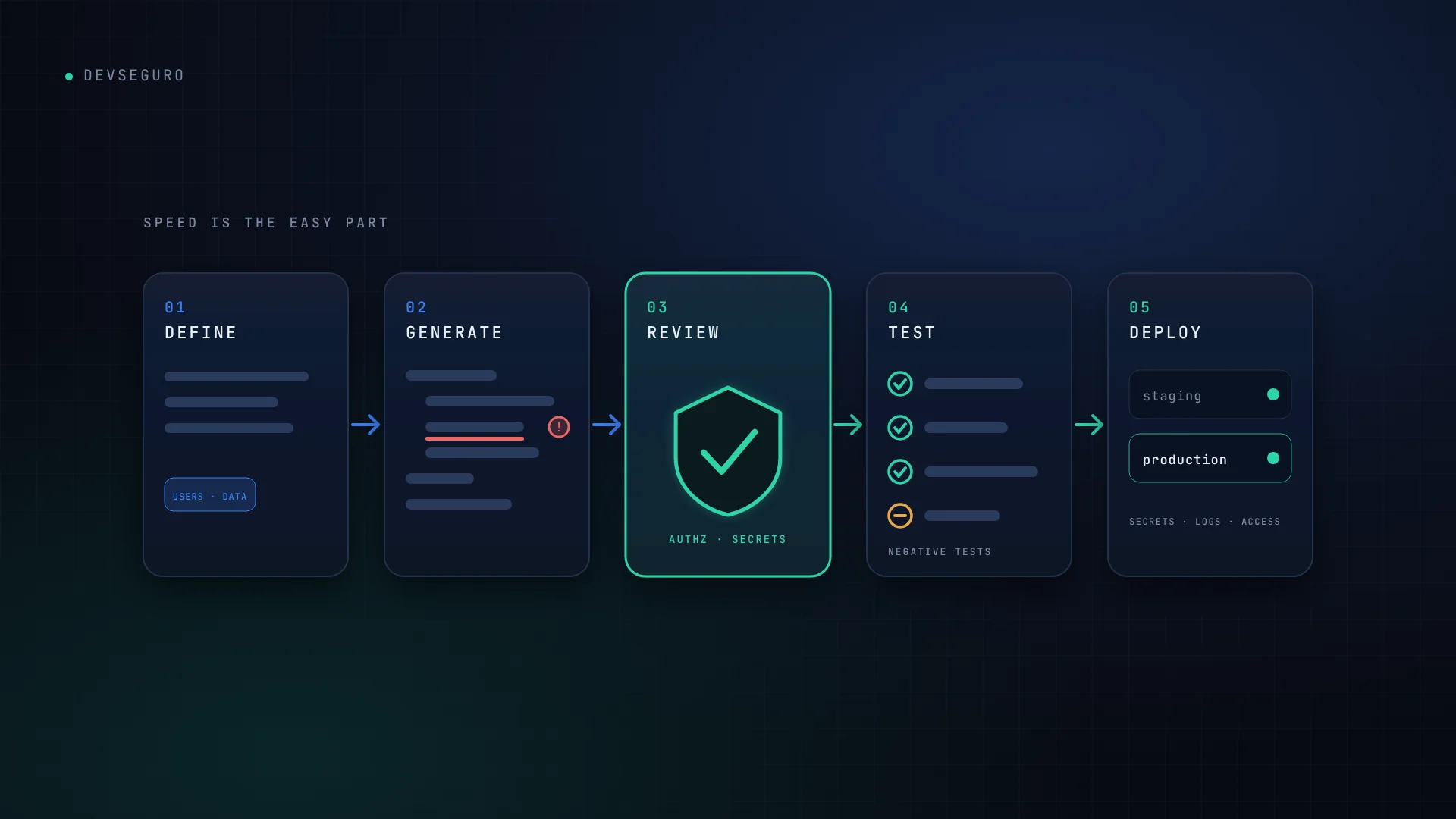
A secure workflow for AI-assisted development
AI can remain part of an efficient development process. The important step is to make security review part of that process rather than an optional task at the end.
Does your AI-built application need a security review?
Consider an independent review if your application processes customer information, includes authentication, connects to external APIs, handles payments, or has recently undergone a major code change.
The appropriate scope depends on the application’s architecture and business impact. A static marketing website and a multi-user application handling confidential records do not have identical security requirements.
A review can identify weaknesses, prioritize remediation, and help the development team understand which issues need attention before launch or further growth.
Build faster without treating security as an afterthought. DevSeguro combines web development and cybersecurity perspectives to help businesses create digital experiences with practical security built into the process. Talk to us about secure web development or an application security review.